The 40mph Rule: Why a Stiff Breeze Quietly Rewrites Your Train Timetable
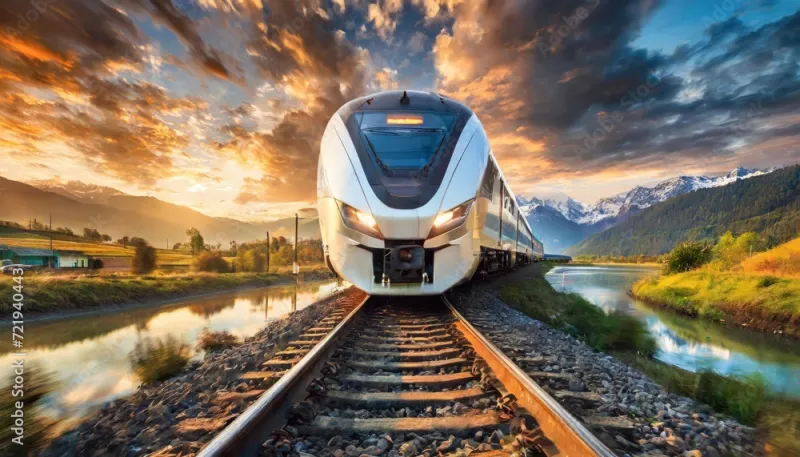
Photo: train crossing exposed viaduct in windy weather UK, via as1.ftcdn.net
It's a blustery Tuesday morning and your 07:42 to Leeds is trundling along a stretch of line it normally takes at a clip. No announcement, no apology, just a slow crawl past a viaduct and a muttered 'weather' from the guard. You arrive eleven minutes late, shrug, and get on with the day.
What actually happened is less mysterious than it feels. Somewhere in a Network Rail route office, a wind-speed threshold was crossed, and a pre-agreed rule kicked in. The train didn't break. The weather didn't defeat the railway. A number in a document you will never read dictated that 90mph was no longer sensible.
Who decides that your train has to slow down
Network Rail owns and operates the track, so it sets the vast majority of weather-related speed limits. Each route has a weather response plan — a working document that lists structures, embankments and stretches of line deemed exposed, and pairs them with wind speeds that trigger action.
Those triggers are not uniform. A coastal embankment in Cumbria with nothing between it and the Irish Sea will get a restriction at a lower gust speed than a suburban line hemmed in by houses and trees. Viaducts — Ribblehead, the Royal Border Bridge, the stretch over the Tay, the long crossings in the south-west — get their own treatment, often with anemometers mounted lineside feeding real-time readings to control.
Train operators sit on top of this. Rolling stock behaves differently in wind: a lightweight diesel multiple unit gets knocked about more than a heavy intercity carriage, and operators agree their own wind management arrangements with Network Rail. That's why a gust can mean a crawl for one service and business as usual for another on the same afternoon.
Why the same gust means two different things
This is the bit that drives passengers round the bend. On a genuinely windy day you can watch the departure boards and see a train to Carlisle delayed by 'weather' while a train to Cambridge runs to time.
The explanation is exposure. A route's risk is judged on the terrain it crosses, the height of the structures, the direction of the wind relative to the track, and how quickly a gust is forecast to arrive. Wind from the south-west hitting a north-facing viaduct is a different problem from the same wind pushing along a sheltered cutting.
There's also a timing question. Forecasts are modelled hours ahead; measured gusts are real. Control rooms will sometimes pre-emptively impose a restriction before the worst arrives, and sometimes lift it early once readings settle. If you're on the 16:20 and the wind has dropped, you may still be held to a speed limit set at lunchtime — because the paperwork hasn't caught up with the weather.
The speed restriction ladder
In practice, wind management comes in a few flavours. A blanket speed restriction applies a lower limit across a defined stretch — 50mph, 40mph, occasionally less. An emergency speed restriction is a short-notice, signposted limit, usually imposed for a specific structure or section. And then there's the nuclear option: 'do not travel', which is rare and usually reserved for named storms with a genuine safety case.
Most of the time, though, the railway stays open and simply slows. Points fail, trees come down, and debris finds its way onto the line, so the delays you experience may be a mix of wind and its aftermath rather than the wind alone.
Why nobody tells you
Passengers get 'due to weather' because that is what the operator's disruption messaging system offers. The guard often doesn't know the specific threshold either — the restriction is logged, not broadcast. There's a reasonable argument that a line in the announcement like 'gusts over 50mph on the viaduct, we'll be at reduced speed for the next ten minutes' would do a lot for public patience. The industry has been nudged on this, but progress is patchy and varies by operator.
Your rights when the timetable bends
Here's the part that actually puts money back in your pocket.
Delay Repay is a no-fault scheme. In most cases you are entitled to compensation if you arrive late, regardless of whether the cause was wind, a signal failure or a trespasser. Typical thresholds are 30 minutes for a 50% refund and 60 minutes for the full fare, though a handful of operators pay from 15 minutes. Check your operator's passenger charter — the thresholds are printed there.
- Claim within 28 days of the journey, with your ticket or booking reference.
- Season ticket holders can claim based on the proportional value of a single journey.
- If you abandon a journey because the train is cancelled or delayed, ask for a refund rather than Delay Repay — you can't usually have both.
- If the operator advises 'do not travel', you are entitled to a refund, and you should not be charged an admin fee.
- Automated Delay Repay exists on several operators; if you bought an e-ticket, the claim may be pre-filled for you.
One caveat worth knowing: some charters exclude compensation where a delay was caused by something outside the operator's control and announced in advance. Read the small print before you assume you're covered.
The next time the train drops to 40mph in a breeze, then, it's not superstition or a driver being cautious for the fun of it. It's a rulebook doing its job — imperfectly, quietly, and at your expense unless you claim it back.