The Extra Gust: Why Some High Streets Turn a Breeze Into a Blast
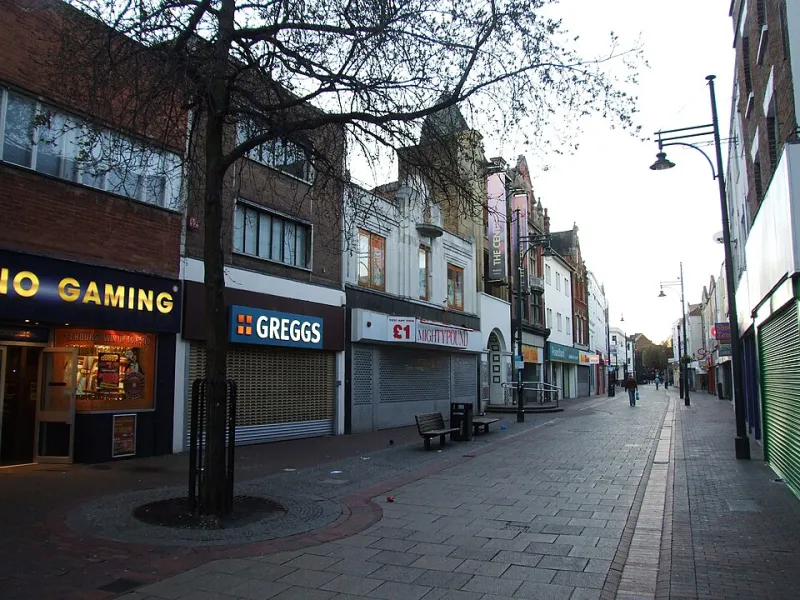
Photo: Chris Whippet , CC BY-SA 2.0, via Wikimedia Commons
There is a particular kind of November morning when the forecast says nothing dramatic — maybe 15mph, maybe a bit gusty — and yet the walk from the council car park to the shops feels like a small expedition. You round the corner by the new glass-fronted block, and suddenly your hood is up, your coffee lid is straining and the bus shelter is doing that rattling thing that never quite becomes a full emergency.
You are not imagining it. Some high streets really do turn an ordinary breeze into a local blast. And quite often, that is not just the weather. It is the shape of the place.
Why a high street can out-gust the forecast
A weather forecast is usually written for a broad area, not for the gap between the pharmacy and the bins. Buildings change how air moves. A tall block can push wind down towards street level. A narrow gap between two shops can squeeze it through faster, as if the high street has been given a nozzle. A row of new towers with a plaza in the middle can create corners where the wind accelerates, then dumps itself on whoever is waiting at the lights.
This is sometimes called a wind microclimate. It sounds technical, and it is. Planners and developers use wind tunnel tests and computer models to work out whether a new scheme will make the pavement uncomfortably gusty. The useful question for shoppers and traders is simpler: did anyone actually test the bit where people stand?
The planning paperwork nobody pins to the lamp post
When a large development is proposed, councils often ask for a wind microclimate assessment. The detail matters. A model that looks at a windy day in the middle of a large open site may miss the nasty little corner by the cashpoint where people queue. A scheme can pass on paper and still leave a bus stop that feels like standing behind a jet engine.
Planning conditions are supposed to catch this. A council might require screens, planting, canopies or a revised entrance layout to soften the worst of it. Sometimes those measures appear. Sometimes they are value-engineered out later, or installed and then quietly removed when a planter is damaged or a bench is moved. The result is a high street that behaves differently from the drawings.
This is not a story about one villain. It is a story about lots of small decisions adding up to a very annoying gust.
Rain shadows and the dry patch by the cashpoint
Wind is only half of it. Buildings and overhangs can create odd dry patches in the rain, which sounds lovely until you realise the water has to go somewhere else. A sheltered doorway may stay dry while the pavement outside turns into a shallow stream. A new canopy can protect one shop front and funnel drips onto the next. Add in street furniture, cycle racks, bins, A-boards and those little barriers nobody remembers installing, and the street becomes a maze of local weather.
Market traders know this better than anyone. A stall that sits fine on a calm day can become impossible when a gust whips between two buildings. Weights get heavier. Tarpaulins get tied down harder. Cups get lids whether the customer wants one or not. It is not glamorous, but it is the practical cost of a design decision made years earlier.
Who actually fixes it?
This is where it gets messy. The developer may be responsible for delivering mitigation set out in a planning condition. The council may be responsible for enforcing that condition. The highways team may own the pavement. A landlord may own the building. A business improvement district or market operator may manage the street furniture. The bus stop might belong to the local authority, the transport authority or a private contractor.
In other words, there is no single gust hotline. If a wind tunnel is making life miserable, the first question is often: whose bit of pavement is it? The second is: was this predicted, and was anything supposed to be done about it?
Post-occupancy monitoring — going back after a building opens to check whether the wind environment actually behaves as expected — is not universal. It should be. A street can look finished and still be a work in progress.
The people at the sharp end
For shoppers, the cost is mostly comfort: a ruined hairdo, a struggle with an umbrella, a bus wait that feels twice as long. For traders, it can be takings. For bus passengers, it can be whether the shelter is usable at all. For anyone with mobility issues, a strong local gust can turn a simple pavement into a hazard.
That is why this is local politics, not just small talk. The next time a planning application lands for a tall block, a new plaza or a revamped shopping parade, look for the wind assessment. Ask whether the bus stop has been modelled. Ask what happens at the market stalls. Ask who pays if the screens fail.
And if your high street already has a gust problem, the answer is not to shrug. It is to find out whether someone promised to fix it — and whether anyone has checked since.