The Switch-Off Cheque: Why a Blustery Week Can Pay a Wind Farm to Stand Still
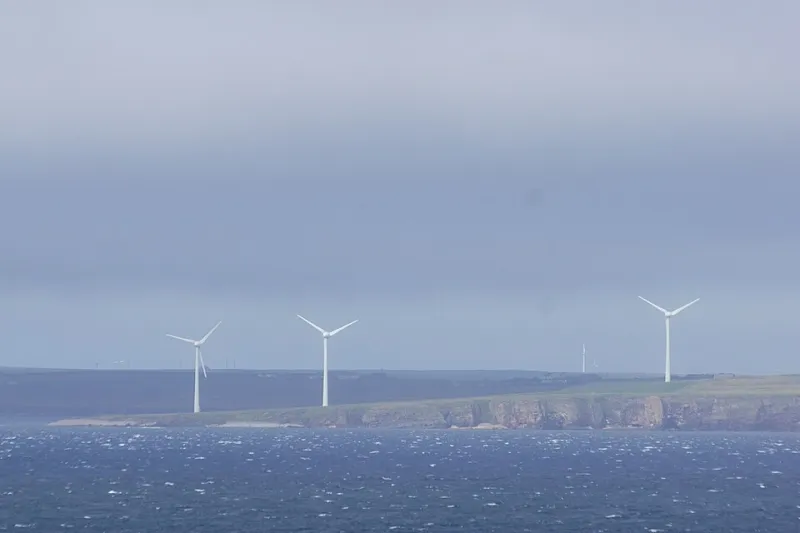
Photo: Mike Pennington , CC BY-SA 2.0, via Wikimedia Commons
It's a grey, gusty Tuesday in November. The sort of day when the turbines on the hills are doing precisely what they were built for. And somewhere in a control room, a wind farm is being asked to slow down — and, in effect, paid for the privilege.
That idea, that Britain pays wind farms to switch off, has become a fixture of the energy argument. It sounds absurd, and it's often presented as proof that renewables are a con. The reality is stranger and considerably duller: a tale of geography, cables, and a grid designed around coal pits rather than wind farms.
The problem isn't the wind. It's the postcode
Scotland hosts the bulk of Britain's onshore wind. Demand sits in England, particularly London and the South East. On a blustery day, wind farms north of the border can generate more electricity than the transmission lines heading south can physically carry.
So you get a bottleneck. Engineers call it a constraint. The system operator then has a choice: pay a generator to turn down, or magic up a cable that hasn't been built yet. It goes for the cheque.
Who actually cuts the cheque
The National Energy System Operator, or NESO, runs the balancing mechanism — the market that keeps supply and demand in step second by second. When the network is stretched, it takes bids from generators who are willing to reduce output. A wind farm that agrees gets compensated for the electricity it didn't produce. Gas plants get paid too, sometimes to do the opposite and ramp up. The mechanism is not a wind-only club, however it's reported.
What catches the eye is the scale. In recent years, constraint payments have run well past a billion pounds annually, with wind accounting for a large slice as capacity has grown faster than the wires connecting it. Those costs don't vanish. They're spread across electricity bills, which is why the phrase 'paid to switch off' lands so badly in a decade of tight household budgets.
Why the payment isn't free money
A turbine that's told to stop doesn't simply lose nothing. The owner loses revenue it would have earned, and under contracts designed to make renewables bankable, it may still be owed support payments linked to output. Compensation covers that gap — and, depending on the auction, the generator's bid can land below or above what the market would have paid.
There is also a genuine engineering point buried under the outrage. Building a network big enough for the windiest few per cent of hours is extraordinarily expensive, and most of it would sit idle the rest of the year. Paying for flexibility is, in some hours, the cheaper option. Batteries are starting to hoover up some of those curtailed electrons, and negative prices — where generators effectively pay to keep producing — are part of the same picture.
None of which makes the current arrangement elegant. Paying wind farms to stop while gas plants fire up is a hard sell on a leaflet.
The political weather
The row has a strong regional flavour. Scottish politicians of several parties have argued that their constituents host the turbines while bill-payers elsewhere collect the frustration. Rural campaigners squeeze it into the same argument as pylons, substations and the long-running tussle over who should see new infrastructure from their kitchen window.
Expect to hear the phrase 'Scotland's wind, England's bills' again before the winter is out. Expect, too, the counter-argument that the whole country benefits from cheaper generation and that the fix is more wire, not fewer turbines.
What changes, and what it does for your bill
Two new subsea links between Scotland and England — part of a wider round of network investment — are meant to ease the squeeze later this decade. Grid reform, faster connections for batteries, and more flexible demand from industry all chip away at the problem.
For 2026, though, the direction of travel on bills is what matters. Constraint costs are not the biggest line on your energy statement — standing charges and wholesale prices are far heavier — but they are a visible symbol of a network playing catch-up. When the wind blows hard and the wires fill up, the money moves around, and eventually it moves through your direct debit.
The short version
Britain hasn't built enough grid to move northern wind to southern sockets, so it sometimes pays generators to stand down. That is wasteful, fixable and less sinister than the headlines suggest — but the bill is real, and it lands on everyone. Which is why the windiest weeks of the year are also the ones where energy policy gets loudest.